Driving Sustainable Investment: Understanding the DIN EN 17463 (VALERI) Standard
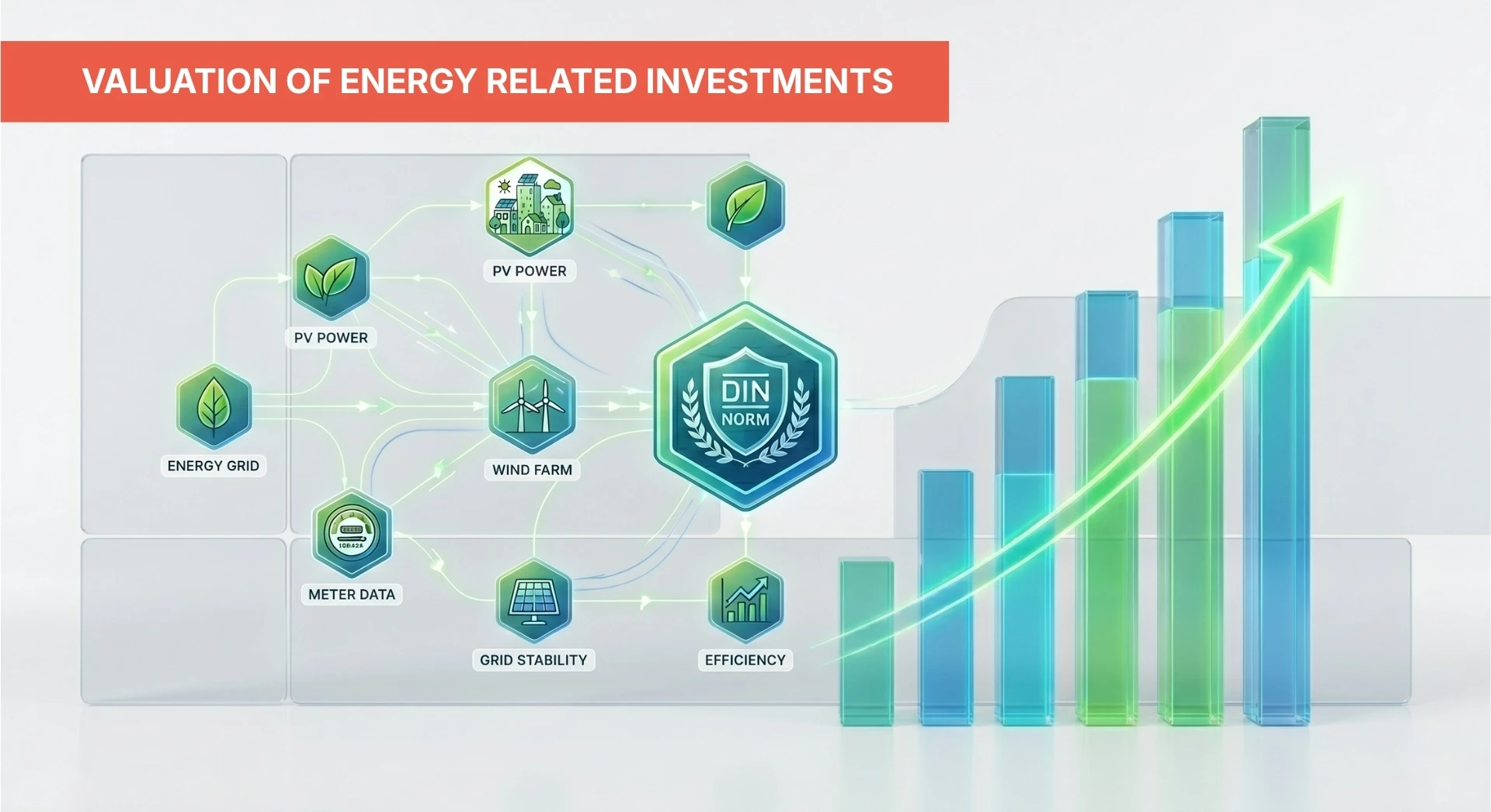
Up until 2021, companies faced a lack of standardized approaches to evaluate the monetary effect of energy-related investments. The DIN EN 17463 (VALERI) standard fills this gap by providing a globally applicable, harmonized methodology for the financial valuation of energy efficiency and energy management-related projects. For businesses, VALERI ensures that potential projects—from simple insulation to complex process optimization—can be compared using a standardized approach. This standardization eliminates valuation variability, de-risks investment decisions, and ultimately drives capital toward the most financially sound, sustainable projects within a company.
1. What is VALERI (DIN EN 17463)?
DIN EN 17463 VALERI, an acronym for Valuation of Energy-related Investments, standardizes the financial appraisal of investments aimed at improving energy efficiency, reducing energy consumption, or managing energy use. Examples of such investments include new HVAC systems, thermal insulation, industrial process optimization, or even complex interconnected solar- and battery-storage systems.
It is critical to note that VALERI is a financial standard, not a technical one. It defines a mandatory financial process and a key metric (NPV) but does not provide technical specifications for the energy projects themselves. The standard ensures that the financial valuation of investment costs and savings is consistent but only provides limited guidance on how to estimate these costs and savings in the first place.
2. Step-By-Step Requirements
The VALERI standard mandates a clear, four-phase process to ensure a compliant financial valuation:
Definition of a System Model
In this phase, a model representing the planned energy investment is defined. This model covers all qualitative and quantitative benefits and burdens and all relevant parameters like price fluctuation or system degradation (i.e., the reduction of output of solar panels caused by aging).
- Identification of all quantitative and qualitative benefits and burdens
- Quantification of the effect of these burdens, wherever possible
- Monetization of all quantified benefits and burdens
- Definition of relevant time effects (e.g., project duration, maintenance frequency)
- Definition of relevant parameters like price increases and degradation
Usually, this phase is the most effortful part of a VALERI assessment, as all required input data needs to be identified, collected, and prepared, which includes making educated decisions on uncertain data points and assumptions.
Calculation
The VALERI standard requires the calculation of the net present value (see below). To calculate this, all cash flows during the project's duration are discounted to today's value, considering a discount rate reflecting the company's cost of capital. Additionally, the sensitivity of all parameters is calculated, and different scenarios (best case, default, worst case) for all parameters are prepared.
Assessment
In this phase, the output of the calculation phase is assessed, and reasonable scenarios are defined. This concludes with a recommendation if the project should be conducted.
Reporting
Finally, all assumptions and findings are collated in a report, which can optionally be externally certified.
3. Why VALERI Uses Net Present Value (NPV) Instead of RoI or IRR
The VALERI standard strictly mandates the use of Net Present Value (NPV) as the primary financial metric over other common measures like Return on Investment (RoI) or Internal Rate of Return (IRR) because of NPV's superior financial integrity:
NPV Superiority
NPV directly calculates the absolute monetary value (in today's currency) created by the investment. Crucially, it accounts for the time value of money, providing a clear figure for the wealth generated.
Limitations of IRR
IRR represents a percentage return, which can be misleading for projects with unconventional cash flows or different scales. It does not indicate the size of the value created, making absolute comparison difficult.
Limitations of RoI
RoI often neglects the time value of money entirely and may not consistently capture the full project lifecycle, leading to an incomplete financial picture.
4. Caveats / Shortcomings
While VALERI effectively standardizes the valuation process, it has recognized limitations concerning the quality and nature of the input data.
The standard explicitly provides no guidance on how future energy consumption and associated costs should be estimated; these figures are considered a given input to the valuation process. Consequently, the estimation of future energy savings (e.g., predicting future energy prices or operational savings) remains highly subjective. Since the input estimation is not standardized, two compliant VALERI calculations can produce vastly different NPVs based solely on differing assumptions about energy price trajectories or energy-saving potentials. This inherent subjectivity can decrease the true project comparability that the standard aims to achieve.
Recommendation
Companies are advised to reduce this uncertainty by pre-defining input data like energy prices and providing central guidance on usual assumptions. This way, the assessment can be delegated within the organization while still ensuring comparability between projects and business units.
Another caveat is the limitation on net present value as the sole allowed assessment criteria. While NPV is fundamentally sound and the most reasonable decision criteria, it is not well-known outside financial expertise compared to simpler metrics like Return-on-Investment, and requires explanation to be understood.
5. Conclusion
The DIN EN 17463 (VALERI) standard is a relevant tool for organizations looking to professionalize their approach to energy efficiency investments, especially when these investments are evaluated in different business units or departments. However, due to the lack of guidance in setting up input data and making assumptions, companies must define their own guidelines, which makes cross-company comparisons almost impossible.
The focus on net-present-value assessments is methodologically sound and enables the correct decisions but makes the results difficult to understand by experts without a financial background. All considered, the standard is an excellent method to prioritize energy efficiency projects from a financial perspective, but additional tools are required to identify relevant projects in the first place, to identify and evaluate their saving potential and investment needs, and to translate results into clear recommendations.
📧 Interested?
If you're currently working on prioritizing measures, implementing them, or finally getting a better overview – feel free to write to us. We'll show you, without obligation, how dauri supports you in planning, implementation, and impact measurement.
📧 Simply send an email to hello@dauri.de or book an appointment directly.